

Women You Should Know: Jessica Swift, Artist and Surface Pattern Designer
Women You Should Know, formerly FemGen Spotlight, is all about connecting women to each other so that we can all feel the strength of a community that stretches far and wide. This month's featured Woman You Should Know came into my orbit in that organic way of a friend saying, "hey, you should meet my friend Jess." And just like that, I got introduced to Jessica Swift, a Portland-based artist, surface pattern designer, author, and online educator whose work has shown up on fabric, clothing, home goods, and more. I sat down with Jessica to talk about creativity, money, and what it actually looks like to build a thriving business out of something you love. I hope you take something from her story too.
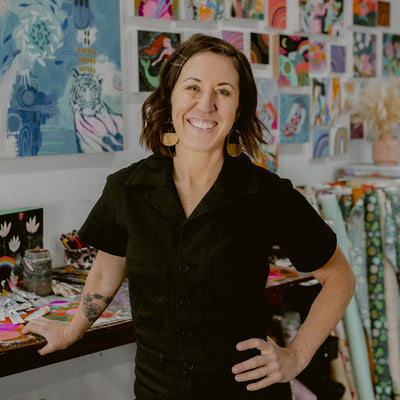
My earliest memories are of making things. I have always been somebody who loves making things and combining colors in interesting ways, and I just love the magic of making something out of nothing. That is really at the root of it all. It is a love of spending time being creative.
I did not know anything about anything when I started. I got a degree in oil painting, so my schooling was very traditional and not focused at all on how to be a working artist. Everything I have learned about how to make money, how to run a business, how to market myself, how to use the tools that have opened up new revenue streams for me, I have taught myself. My whole career has been one long learning curve.
And then from a different angle entirely, imposter syndrome has been a huge challenge. Doubting myself, comparing myself to other people, wishing I could do things the same way or as well. I think that is something a lot of women are particularly good at. The learning curve has been figuring out how to feel those things and move forward anyway, and not let them stop me.
Hiring an assistant. I hired one for the first time about a year and a half ago, and it has been really amazing to have somebody in the thick of it with me. It took some time to figure out how and where to best use her, but now that we have gotten to know each other better, she has been a huge help. And the way it happened is very on brand for how things seem to unfold for me. She actually emailed me out of the blue. Her job was ending and she reached out on a total shot in the dark to ask if I was looking for help. I had been thinking about it for a long time but was not quite ready to put out the call, and then there she was. It felt like a sign.
I feel most confident when money is rolling into my bank account on the regular, and least confident when it is not. My income is not regular. It comes in waves and chunks and weird timing, and even though I know that intellectually, the lulls are not always very fun. I navigate that partly by living well below my means, and partly because I have had a really wonderful financial planner for many years. Every time I talk to him, he reminds me that I am on track, that things are going well, and that my mind is doing that thing where it worries for no actual reason on paper. That reassurance matters more than I can say.
I max out every investment opportunity I can. I contribute to my Roth IRA and a Solo 401k every year, and that feels like a top priority. Beyond that, I try to be frugal. I invest in my business when it feels important to do so. I was in a business mastermind for a couple of years because I wanted to learn, and then I decided that was not where I needed to put money this year, so I stepped away. It is more intuitive than strategic, honestly. I look at things and think, there is always enough, and it seems to be growing. I trust that.
What stayed with me after talking with Jessica is something she said almost in passing: that she sometimes catches herself internally apologizing for wanting to make money. She said she wishes women could talk more openly about wanting financial success, not as a side effect of doing meaningful work, but as a goal in its own right.
I could not agree more. So much of what holds women back financially is the story we carry that ambition around money is somehow at odds with being a good person, or a real artist, or a generous community member. I struggle with that too and have to actively remind myself that wanting your work to be financially successful is not a character flaw. It is how you stay in the game, keep doing what you love, build something that lasts, and invest back into your community.
The conversation with Jessica was a reminder that women can help each other with changing this mindset. Forgive the platitude, but a rising tide really does raise all ships.
Think about one area of your financial life where you have been internally apologizing for wanting more. More income, more savings, more confidence, more options. Name it out loud, even if just to yourself. Ambition is not something to manage down. It is something to build on.
And if you have been putting off getting a financial plan in place because it feels overwhelming or like something you will do later, this is your nudge. Later has a way of staying later.
- Website: jessicaswift.com
- Instagram: @jessicaswift
Thanks for reading this edition of Women You Should Know. If you know a woman who is building something meaningful and navigating money with intention, reply and tell me about her.
Subscribe to the FemGen Spotlight here.
Links to external sites are provided for your convenience in locating related information and services. Guardian, its subsidiaries, agents and employees expressly disclaim any responsibility for and do not maintain, control, recommend, or endorse third-party sites, organizations, products, or services and make no representation as to the completeness, suitability, or quality thereof.